
DSCR Loans for Real Estate Investors
Qualify on your property’s rent — not your tax returns. Direct DSCR lender, nationwide. No minimum credit score. No minimum DSCR. Close fast.
- No Credit-Score Cutoff
- DSCR Below 1.0 OK
- Up to 85% LTV
- Close Fast
AAPL Member · Direct Lender Since 2016 · NMLS #1979189
We also fund investors across Texas, Florida, Georgia, Ohio, Louisiana, Tennessee, and Indiana.
Written and reviewed by Kyle Farmer, Lead Account Executive at Tidal Loans
DSCR Loans in Brief
- Qualify on rent, not income — no tax returns, W-2s, or pay stubs required
- No minimum credit score and no minimum DSCR — lower numbers mean adjusted terms, not a denial
- Up to 85% LTV on purchases (as little as 15% down)
- Close in your LLC — keeps the loan off your personal credit
- Investment property only — we never lend on owner-occupied homes
- Direct lender — we move fast
Tidal Loans has financed real estate investors nationwide since 2016.
I’ve sat across the table from hundreds of investors who were ready to close on a solid rental property and got stopped cold by a loan officer asking for two years of tax returns. They had the deal. They had the down payment. What they didn’t have was a W-2 that fit neatly into a conventional underwriting box — because they were self-employed, already owned a dozen properties, or wrote off enough on paper that their “income” looked thin. DSCR loans exist for exactly those people, and at Tidal Loans we’ve built a large part of our business around them since 2016.
A DSCR loan lets you qualify for investment property financing based on the income the property itself produces, not the income you personally report to the IRS. If the rent covers the mortgage, you have a path to funding. That single shift — from underwriting you to underwriting the deal — is why debt service coverage ratio loans have become the default financing tool for serious rental investors.
What Is a DSCR Loan?
A DSCR loan is a mortgage for investment property that qualifies the borrower using the debt service coverage ratio — a simple measure of whether the property’s rental income covers its debt payments. The term comes straight out of commercial lending, where banks have always cared more about whether a building cash-flows than whether its owner has a steady salary. DSCR loans bring that same logic to one-to-four-unit residential rentals, short-term rentals, and small multifamily buildings.
Here’s the part that surprises first-time DSCR borrowers: there’s no income verification in the traditional sense. No tax returns, no W-2s, no pay stubs, no employment letter, and usually no debt-to-income calculation on your personal finances. The lender looks at the lease (or the market rent), looks at the property’s total monthly payment, and runs one ratio. Investopedia’s breakdown of the debt service coverage ratio is a clean reference for the underlying concept.
Because the property qualifies itself, DSCR loans are also called no-income-verification investor loans, investor cash-flow loans, or simply rental loans. They are not consumer mortgages — you cannot use a DSCR loan to buy a home you intend to live in.
How the Debt Service Coverage Ratio Actually Works
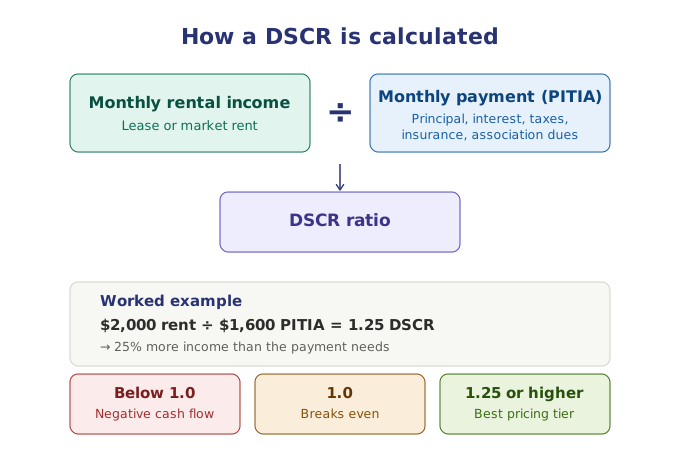
The ratio is the whole game, so it’s worth understanding the math before you apply. The formula is:
DSCR = Monthly Rental Income ÷ Monthly Debt Payment (PITIA)
PITIA stands for principal, interest, taxes, insurance, and any association dues — the full cost of carrying the property each month. You divide the rent by that number, and the result tells the lender how comfortably the property pays for itself.
Say a single-family rental brings in $2,000 a month and the full PITIA payment is $1,600. Divide $2,000 by $1,600 and you get a DSCR of 1.25 — the property generates 25% more income than it needs to cover the debt. A DSCR of exactly 1.0 means the property breaks even, and below 1.0 the property is “negative cash flow” on paper. Most lenders cut those deals off — but as you’ll see in our requirements, we don’t.
DSCR Calculator
DSCR Loan Calculator
Estimate whether your investment property qualifies for a DSCR loan. Enter the property value, loan terms, and expected rent to see your DSCR, estimated payment, potential loan size, and rental income needed to qualify.
How to Use This Calculator
Loan & Property Inputs
Advanced Stress Test
Results
- A DSCR of 1.00 means rent equals debt service.
Pressure-test a deal in seconds — enter the monthly rent and the full PITIA payment to see the ratio before you ever pick up the phone.
On short-term rental deals the income side is often based on projected revenue rather than a signed lease — we handle those under our short-term rental and Airbnb financing program.
Who DSCR Loans Are Built For
In my experience, four kinds of investors gravitate toward DSCR financing. The first is the self-employed or 1099 investor whose tax return is engineered to minimize taxable income. The second is the portfolio investor who has hit the conventional property-count wall; DSCR lenders generally don’t cap how many properties you own. The third is the BRRRR investor, since the DSCR loan is the “refinance” engine of that whole strategy. And the fourth is the busy investor who values speed and simplicity — far less paperwork and faster closings.
DSCR Loan Requirements
The ratio itself is the headline — but we have no minimum DSCR requirement. We fund deals at 1.25 and above for the strongest pricing, but we also routinely fund below 1.0 and even below 0.75. A lower ratio means a lower LTV and a higher rate, not an automatic decline.
Credit score still matters for pricing, even though personal income doesn’t. We have no minimum credit score — but We do review credit, and your score directly affects your terms. A low score doesn’t disqualify you; it’s simply priced in.
Down payment typically runs as little as 15% on a purchase, putting you at up to 85% loan-to-value. Cash reserves are part of nearly every approval, and because these are business-purpose loans, you can close in the name of an LLC.
See if your deal qualifies — get a real quote in 24 hours.
DSCR Loan Rates and Terms
DSCR loan rates generally sit a bit above conventional owner-occupied mortgage rates — usually from roughly 0.5% to 1% higher, depending on the market and your file. Three factors move your rate more than anything else: the DSCR ratio, your credit score, and your loan-to-value. Most DSCR loans are written as 30-year fixed mortgages, with interest-only and adjustable structures available. Prepayment penalties are common — typically a step-down over the first few years — and we walk every borrower through that before closing.
DSCR Loans vs. Conventional Loans
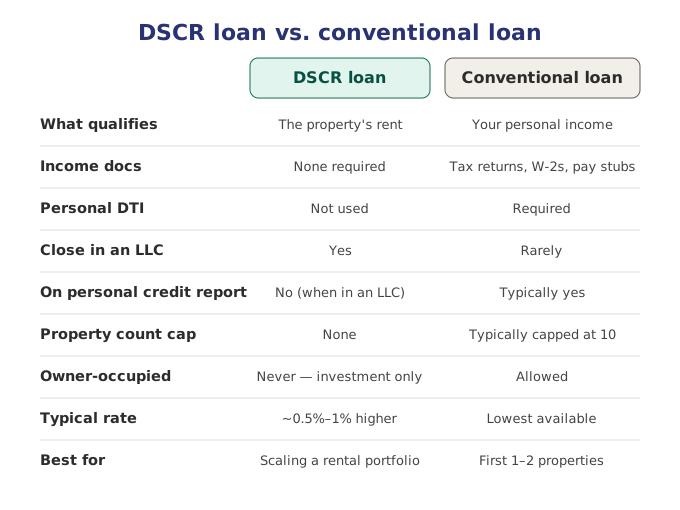
A conventional loan qualifies you — it scrutinizes your tax returns, calculates your personal debt-to-income ratio, verifies your employment, and caps how many properties you can finance. A DSCR loan qualifies the property. It ignores your tax returns, uses the rent-to-payment ratio in place of personal DTI, lets you close in an LLC, and doesn’t cap your property count. For an investor building a rental portfolio efficiently, that trade is usually a no-brainer.
If tax returns and pay stubs are the sticking point, see how no-income-verification investment property loans are underwritten.
The BRRRR Strategy and Cash-Out Refinancing
The BRRRR method — buy, rehab, rent, refinance, repeat — depends on being able to pull your capital back out of a stabilized property so you can redeploy it into the next deal. You buy a distressed property with short-term fix and flip financing or a bridge loan, renovate it, place a tenant, then refinance into a long-term DSCR loan that pays off the short-term debt and — if the property appraised up enough — returns your original cash through a cash-out refinance.
Run your numbers with our DSCR calculator.
Property Types We Finance
DSCR financing is broad: single-family rental homes, two-to-four-unit residential properties, warrantable condos and townhomes, and short-term and vacation rentals through our Airbnb and short-term rental loans. Once a building reaches five units, it crosses into our multifamily loan program.
How to Apply With Tidal Loans
We’re a direct lender, not a broker passing your file down the line. You start by telling us about the property and the deal — the purchase price or current value, the rent or market rent, and your rough credit picture. We run the DSCR and give you a real, scenario-specific quote rather than a teaser rate. From there, the documentation is light, with no chasing tax transcripts or employment letters.
Why Investors Choose Tidal Loans
Tidal Loans has been financing real estate investors since March 2016, and we’re a Houston-based direct lender that funds deals nationwide. Built and backed by our founders, the company was created specifically around investor financing rather than bolting it onto a consumer mortgage shop — and that focus shows up in how we underwrite, how fast we move, and how well we understand the strategies our borrowers are actually running.
DSCR Loans by State
Lending rules, rents, and investor markets vary from state to state, so we maintain dedicated DSCR resources for the markets we’re most active in — Texas, Florida, Georgia, Tennessee, Louisiana, Ohio, and beyond. If you’re investing in a specific state, reach out and we’ll point you to the right resource or quote your deal directly. Financing a rental in Virginia? See our Virginia investment property loans page. Financing a Louisiana rental? See our DSCR loans in Louisiana.
Frequently Asked Questions
We don’t have a hard minimum credit score that automatically disqualifies you. We do pull credit — any legitimate lender will — but a lower score doesn’t kill your deal the way it would with a conventional lender. Your score affects pricing and terms: stronger credit earns better rates and higher leverage, while a lower score is offset with a larger down payment, more reserves, or an adjusted rate. The property’s performance carries the deal, not a single number on your credit report.
We don’t have a minimum DSCR ratio. Most lenders cut you off at 1.25 or 1.0, but at Tidal Loans we fund properties below 1.0 — and even below 0.75 — when the rest of the file supports it. A lower ratio just means a lower loan-to-value, additional reserves, or a higher rate to balance the risk.
Yes, and most of our investors do exactly that. Because DSCR loans are business-purpose investment loans rather than consumer mortgages, closing in an LLC is fully supported and often recommended for liability protection and cleaner portfolio accounting. A DSCR loan closed in your LLC’s name also generally won’t appear on your personal credit report.
Most DSCR purchases require 15% to 25% down. At Tidal Loans we can fund up to 85% of the purchase price, which puts you at 15% down. On a refinance, we look at existing equity rather than a cash down payment, typically leaving you at 70% to 80% LTV.
Yes. We don’t require prior investing experience. As long as the property cash-flows and your file meets our underwriting, first-time investors are welcome — a DSCR loan is one of the cleanest ways to finance a first rental because it doesn’t lean on your personal income or employment history.
Most DSCR loans carry a prepayment penalty, typically a step-down over the first few years. We walk every borrower through their specific prepay structure up front, and in some cases the penalty can be bought down for a higher rate if your plan calls for an early exit.
A conventional rental loan qualifies you — your tax returns, debt-to-income, employment, and a cap on financed properties. A DSCR loan qualifies the property, using its rental income against its payment. You trade a slightly higher rate for far less paperwork, LLC vesting, and no cap on how many doors you own.
When there’s no signed lease, we use a market rent estimate, typically supported by an appraiser’s rent schedule. For short-term and vacation rentals, the income side is often based on projected or market revenue, so you can finance a property you haven’t placed a tenant in yet.
Generally no. Unlike conventional financing, which caps the number of financed properties you can hold, DSCR lenders typically place no limit on how many investment properties you own or finance.
No. DSCR loans are strictly for business-purpose, investment, and rental properties — you cannot use one to finance a primary residence or any owner-occupied home.
A hard money loan is short-term, asset-based financing used to acquire or rehab a property quickly, while a DSCR loan is long-term financing that qualifies on the property’s rental cash flow. Many investors use both in sequence: hard money to buy and renovate, then a DSCR loan to refinance into permanent financing once the property is rented and stabilized.
Ready to fund your next investment property?
Get a free, no-obligation DSCR quote.
Or call us: (832) 757-1262