
Multifamily Loans for Real Estate Investors
AAPL Member · Direct Lender Since 2016 · NMLS #1979189
Written and reviewed by Ndukwe Kalu, Managing Member, Tidal Loans · NMLS #1979189 · Last updated July 2026
There’s a moment in a lot of investors’ careers when they outgrow single-family rentals and start eyeing apartment buildings — and they quickly discover the financing rules change at the door. A fourplex and a six-unit building look similar from the street, but to a lender they live in different worlds. Multifamily loans are built for that larger world: five-or-more-unit properties that get underwritten on the building’s income rather than on a simple residential formula. Tidal Loans added multifamily financing to round out the toolkit our investors were already asking for, and this page explains how these loans work and what it takes to qualify.
A multifamily loan finances an apartment or multi-unit residential building of five units and above, where the property is treated as a small commercial asset. The lender’s central question is whether the building’s net income comfortably covers the debt — so the property’s performance, not your personal paycheck, drives the deal. For investors moving up from houses and small plexes into true apartment ownership, it’s the financing that makes the jump possible.
What Is a Multifamily Loan?
A multifamily loan is financing for a residential property with multiple units, and the term most often refers to buildings of five units or more, which cross from residential into commercial lending territory. That five-unit line is the one investors most need to understand. A two-to-four-unit property is still considered residential and can be financed much like a single-family rental — we typically handle those through our DSCR loan program, which qualifies on rental income. Once a building hits five units, it becomes a small commercial asset, and the underwriting shifts to focus on the property’s overall financial performance.
That shift centers on the building’s net operating income, or NOI — the rental income left after operating expenses — measured against the debt. Lenders also look at the property’s value through the lens of its income, often using a capitalization rate; Investopedia’s explanation of the capitalization rate covers how that income-based valuation works. The practical upshot is that a well-run building with strong, stable income is what gets financed and priced well, regardless of how complex your personal tax situation might be.
Like our other investor products, multifamily loans are business-purpose loans secured by the property, so you can close in an LLC and the file is built around the asset.
How Multifamily Loans Work
The heart of multifamily underwriting is the debt service coverage ratio on the building — the same cash-flow logic behind a single-family DSCR loan, scaled up to an apartment property. The lender divides the building’s net operating income by its debt payment; the higher that ratio, the more comfortably the property covers itself, and the better your terms. How much weight the current ratio carries depends on which of our two multifamily products fits your deal — which is the next thing to understand.
Beyond the ratio, the lender looks at loan-to-value, typically funding a portion of the property’s value and asking you to bring the rest as a down payment — often in the range of 25% to 30% for an acquisition. Terms vary by the type of multifamily loan, from short-term bridge structures during a value-add project to longer amortizing loans for a stabilized hold. Because the building’s income carries the loan, the quality and stability of that income — occupancy, lease terms, expense control — matters as much as anything you bring personally.
Stabilized vs. Value-Add: DSCR and Bridge
We finance 5+ unit buildings two ways, and the right one depends on whether the property already performs.
For a stabilized building already generating steady income, our multifamily DSCR loan is the long-term hold financing. Here we underwrite the in-place income, and we generally want to see the building cover its debt — a DSCR around 1.0 or better — with stronger ratios earning better pricing and leverage.
For a building you’re buying to reposition — high vacancy, below-market rents, deferred maintenance — our multifamily bridge loan carries the property through the value-add. On a bridge deal the current, in-place DSCR matters far less, because the whole point is that the income isn’t there yet. Instead we underwrite to the proforma DSCR — what the building will cover once it’s stabilized — alongside two other tests: the debt yield (net operating income divided by the loan amount, which tells us how well the loan is protected regardless of interest rate or cap rate) and an overall profitability test on whether the finished, stabilized deal pencils against your total cost. Get those right and a property that doesn’t cover its payment today is still very financeable.
How We Calculate NOI, DSCR, and Debt Yield on a Multifamily Deal
This is where single-family and multifamily underwriting really diverge, so it’s worth seeing the two side by side. On a 1–4 unit DSCR loan the calculation is deliberately simple: we take the rent and measure it against the payment, where the payment is principal, interest, taxes, insurance, and any HOA dues. The property either covers that number or it doesn’t, and the ratio falls out.
A 5+ unit building is underwritten like the small business it is, so we build a real net operating income rather than a back-of-the-envelope figure. We start with the gross rental income, then subtract the expenses an apartment property actually carries: a vacancy adjustment, so we’re not underwriting to a fully-occupied fantasy; property management; repairs and maintenance; replacement reserves for the big-ticket items that wear out, like roofs, HVAC, and parking lots; insurance; any owner-paid utilities such as water and sewer, electric, gas, and trash; landscaping and pest control; and general administrative costs. We also normalize property taxes — on a purchase especially, the taxing authority usually reassesses the building to the new, higher sale price, so we underwrite to next year’s expected tax bill, not the seller’s old one. Underwriting to the seller’s lower taxes is one of the most common ways a deal looks better on paper than it actually pencils.
The income side gets normalized too. If you’re buying and the prior owner can’t produce a clean trailing-twelve-month (T-12) operating statement, the appraiser steps in with market rents and market expense ratios, so we’re working from defensible numbers rather than a seller’s optimistic spreadsheet. Any other income the building generates — laundry, parking, pet fees, utility reimbursements — is counted on the income side as well.
What’s left after those expenses is the NOI, and that single number drives everything downstream. Divide it by the annual debt payment and you get the DSCR. Divide it by the loan amount and you get the debt yield — the figure that tells us how protected the loan is, independent of rate or cap rate. On a stabilized DSCR loan we run these on the in-place income; on a value-add bridge loan we run them on the proforma, the realistic stabilized NOI once your business plan is executed. Either way the discipline is the same: a defensible NOI built from real expenses is what we lend against, because that’s the number that has to perform after you close.
Types of Multifamily Financing
The most common need is an acquisition loan to buy a stabilized, income-producing building. The property already performs, the income covers the debt, and the loan finances the purchase against that performance.
The second is value-add and bridge financing, where you buy an underperforming building — high vacancy, below-market rents, deferred maintenance — improve it, and refinance once it’s stabilized and worth more. This is where a bridge loan earns its keep, carrying the property through the repositioning period, and it’s the exact role of our existing multifamily bridge loan product. Value-add is one of the most powerful plays in the apartment space precisely because you create value rather than just buying it.
The third is construction, building a small apartment property from the ground up, which we handle through our ground-up construction financing for projects that start at the dirt. And the fourth is the refinance — replacing a maturing loan or pulling equity out of a building through a cash-out refinance to redeploy into the next acquisition.
Multifamily Loan Requirements
Apartment lending asks more of the property and the operator than single-family financing does. Here’s what we focus on.
The building’s income comes first — its net operating income, occupancy, rent roll, and expense history. A stabilized building with clean financials and steady occupancy is the easiest to finance. The debt service coverage ratio has to work, with stronger ratios earning better pricing.
The down payment or equity is generally larger than on a single-family deal, often a quarter to nearly a third of the purchase price, which sets your loan-to-value. Reserves matter more here too, because a larger building has more that can go wrong, and lenders want to see a cushion.
Experience carries weight. Operating an apartment building is a different skill than owning a few rentals, so prior multifamily or substantial rental experience strengthens a file. Newer operators can still get financed, particularly on smaller, stabilized buildings, but the property and the plan need to be solid. Property condition is part of the picture as well — the building’s physical state affects both value and risk.
Credit is reviewed, but we have no minimum credit score on our multifamily loans. We do pull credit — a legitimate lender always will — but a lower score doesn’t disqualify your deal; it’s reflected in pricing, leverage, and reserves rather than an automatic decline. What stays consistent with our other products is that the decision rides on the asset, not your personal income tax returns.
Have an apartment deal in mind? Send us the rent roll and we’ll underwrite it directly.
Small-Balance Multifamily
Not every apartment deal is a hundred-unit complex, and most of ours aren’t. Small-balance multifamily — buildings roughly in the five-to-twenty-unit range — is a sweet spot for many investors stepping up from single-family and small plexes. These deals are large enough to benefit from commercial-style, income-based underwriting but small enough to remain approachable for an individual investor or a small partnership. They’re a natural progression for someone who has built a single-family portfolio and wants the efficiency of more doors under one roof and one loan, and they’re a core part of what our multifamily program is built to serve.
How Multifamily Loans Fit a Portfolio
Apartment financing rarely stands alone — it sequences with the rest of your toolkit. You might acquire a value-add building with a bridge loan, improve it, then refinance into longer-term financing once the income stabilizes. You might build small multifamily ground-up and refinance on completion. Or you might pull equity from a performing building to fund your next acquisition. The throughline is that the building’s income drives every step, the same way a single-family DSCR loan is driven by a house’s rent — just scaled up to a property with more units and more moving parts.
A Multifamily Deal We Recently Funded: 9-Unit Value-Add in Humble, TX
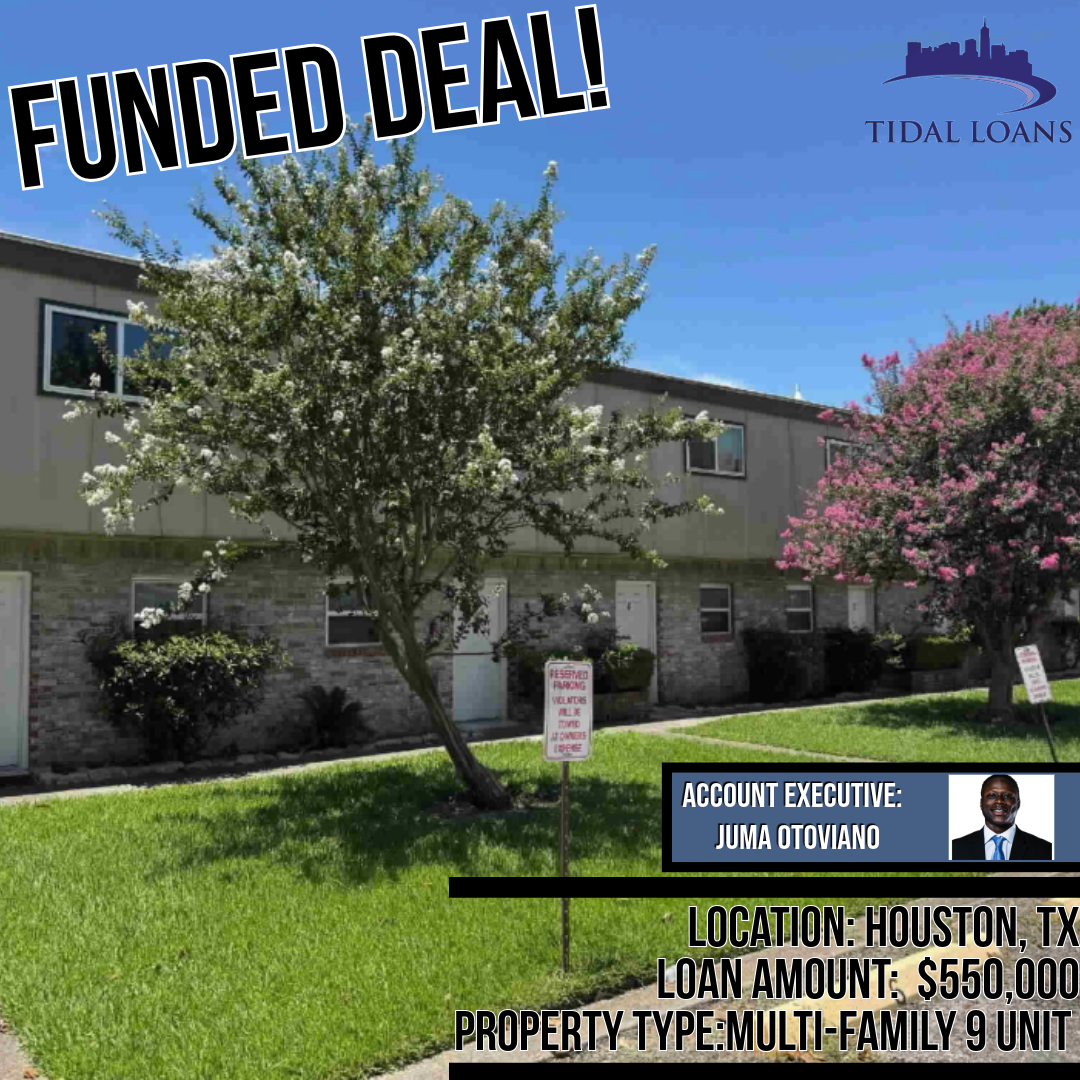
Numbers tell the story better than theory, so here’s a deal we closed in the Houston metro. A seasoned investor owned a 9-unit building in Humble — eight 2-story 2BR/1.5BA units plus a detached 3BR/2.1BA unit, with central HVAC throughout and 18 on-site parking spaces. They had bought it with cash and held it for a few years, and to push rents to market they needed to fully gut and renovate six of the nine units: paint, flooring, tile, countertops, cabinets, doors, plumbing fixtures, and HVAC updates.
Rather than dilute ownership or write a personal check, they came to us for a cash-out refinance to pull the trapped equity back out and fund the work. We underwrote it on the building, not the borrower: an underwritten NOI of $86,494 against a stabilized cap rate of 7.0%. Run the math an apartment lender runs — NOI divided by the cap rate — and that income supports a stabilized value in the neighborhood of $1.2 million, which is what made the structure work. The result was a $550,000 loan that covered 100% of the $500,000 renovation budget.
Because we are a direct lender that underwrites in-house, our team completed underwriting just three days after receiving the appraisal and moved the file straight to cleared-to-close — keeping the renovation timeline intact. That is the multifamily playbook in one deal: the building’s income carried the loan, the structure freed up capital for the value-add, and our speed kept the project on schedule.
Deal Snapshot
Applying With Tidal Loans
As a direct lender, we underwrite multifamily deals in-house, which lets us read a rent roll and an operating statement quickly and give you a real answer instead of passing your file down a chain. The process starts with the building: the purchase price or current value, the rent roll, the operating expenses, the occupancy, and your plan for the property. We’ll run the numbers — the NOI, the coverage ratio, the value — and quote your scenario directly. Because the decision rides on the asset, the personal documentation is lighter than a bank would demand.
Investors tell us they value a lender that actually understands apartment economics — one that reads the financials critically and structures the loan around how the building really performs. We’d rather get the numbers right than paper over a weak rent roll.
Why Investors Choose Tidal Loans
Tidal Loans has financed real estate investors since 2016 as a Houston-based direct lender working nationwide. Our founders built the firm around investor financing, and adding multifamily was a direct response to investors who’d grown their portfolios with us and wanted to move up into apartments. We understand the step up from single-family to multi-unit ownership, the value-add play, and the income-based underwriting that governs these deals — and much of our business comes back to us as investors scale. We finance apartment deals nationwide, including multifamily loans in Florida.
We finance apartment deals nationwide, including multifamily loans in Georgia.
We finance apartment deals nationwide, including multifamily loans in Tennessee.
We finance apartment deals nationwide, including multifamily loans in Louisiana.
We finance apartment deals nationwide, including Ohio multifamily loans.
Multifamily Loans by State
Apartment values, rents, occupancy, and investor demand vary widely from market to market, so we maintain dedicated multifamily resources for the states we’re most active in. As those state pages go live they’ll be linked here, covering local conditions across markets like Texas, Florida, Georgia, Tennessee, Louisiana, Ohio, and beyond. If you’re pursuing an apartment deal in a specific state, reach out and we’ll underwrite it directly.
Frequently Asked Questions
Multifamily loans generally finance buildings of five units or more, which are treated as small commercial assets and underwritten on the property’s income. Two-to-four-unit properties are still considered residential and are typically financed like single-family rentals through a DSCR loan. That five-unit line is the key threshold — it’s where the underwriting shifts from a simple residential approach to an income-and-expense analysis of the whole building.
Down payments on multifamily acquisitions are usually larger than on single-family deals, often in the range of 25% to 30% of the purchase price, which sets your loan-to-value. The exact figure depends on the building’s income strength, your experience, and the loan type. A stronger debt service coverage ratio and a stabilized, well-occupied building can improve your terms and the leverage a lender is comfortable extending.
The building’s. Multifamily lending centers on the property’s net operating income measured against the debt — the debt service coverage ratio — rather than on your personal income or tax returns. A well-run building with steady occupancy and controlled expenses is what drives approval and pricing. Your experience and reserves matter, but the property’s financial performance is the foundation the loan is built on.
Yes. Value-add deals are a major use of multifamily financing. Investors commonly use a bridge loan to acquire an underperforming building, improve occupancy and rents, then refinance into longer-term financing once it’s stabilized and worth more. This lets you create value through better operations rather than just buying an already-perfect building, and it’s one of the most effective strategies in the apartment space.
Experience helps and strengthens your file, since operating an apartment building is more involved than owning a few rentals, but it isn’t an absolute requirement. Newer operators can often qualify on smaller, stabilized buildings where the income is steady and the plan is straightforward. As the deal size and complexity grow, lenders weigh your track record more heavily, so a solid property and a clear plan matter most early on.
Yes, and most of our investors do. Multifamily loans are business-purpose loans secured by the property, so closing in an LLC is fully supported and usually recommended for liability protection and cleaner portfolio accounting. You’ll provide your entity documents — operating agreement and articles of organization — during underwriting. A loan closed in your LLC’s name also generally won’t appear on your personal credit report.
Because we’re a direct lender that underwrites in-house, we move quickly. On a recent 9-unit cash-out refinance in Humble, TX, our team completed underwriting just three days after receiving the appraisal and moved the file straight to cleared-to-close. Most deals close in a couple of weeks depending on the appraisal and how fast the rent roll, operating statements, and entity documents come back — there are no personal tax transcripts to chase the way a bank would.
Both finance 5+ unit buildings; the difference is whether the property is stabilized. A multifamily DSCR loan is long-term financing for a building that already performs, underwritten on its in-place income. A multifamily bridge loan is short-term financing for a building you’re acquiring or repositioning, underwritten on what the property will produce once stabilized — its proforma income — rather than its current numbers. Many investors run them in sequence: bridge to buy and improve, then refinance into a DSCR loan once occupancy and rents stabilize.
Yes. A cash-out refinance lets you pull trapped equity out of a building you already own and redeploy it into a value-add renovation without diluting ownership or using personal funds. On a recent 9-unit deal in Humble, TX, we structured a cash-out refinance that covered the full renovation budget so the investor could reposition the property and push rents to market. We underwrite the cash-out on the building’s income and value, so a well-performing or repositionable asset is what drives the proceeds available to you.
It depends on which multifamily product fits your deal. On a stabilized multifamily DSCR loan, we generally like to see the building’s in-place income cover its debt — a DSCR around 1.0 or better — and stronger ratios earn better terms. On a value-add multifamily bridge loan, the current ratio matters much less; because the income isn’t stabilized yet, we underwrite to the projected (proforma) DSCR once the building is repositioned, along with the debt yield and an overall profitability test on the deal. For 1–4 unit properties, which we finance through our standard DSCR program, there’s no minimum DSCR at all.
We build net operating income from the building’s gross rental income minus the real costs of running it: a vacancy adjustment, property management, repairs and maintenance, replacement reserves, insurance, any owner-paid utilities, landscaping, pest control, and administrative costs. We normalize property taxes to next year’s expected bill, since a purchase is usually reassessed to the higher sale price, and when a seller can’t provide a clean trailing-twelve-month (T-12) statement the appraiser uses market rents and expenses. Other income like laundry, parking, and utility reimbursements is added back in. The resulting NOI is divided by the debt payment to get the DSCR and by the loan amount to get the debt yield. On a 1–4 unit DSCR loan the math is far simpler — we just measure rent against principal, interest, taxes, insurance, and any HOA dues.
We don’t have a minimum credit score for our multifamily loans — this applies across our 5+ unit DSCR and bridge programs as well as our 1–4 unit DSCR loans. We do review credit, but a blemish that would sink a bank application often won’t stop a deal here. It’s priced in: stronger credit earns better rates and leverage, while a lower score is offset with a higher rate, lower leverage, or additional reserves. On a multifamily deal, the building’s income and the strength of the plan carry the most weight.
Ready to finance your next multifamily property?
Get a free, no-obligation quote — or call us and walk a deal through with an underwriter.