
Ground-Up Construction Loans in Texas
AAPL Member · Direct Lender Since 2016 · NMLS #1979189
Written and reviewed by Ndukwe Kalu, Managing Member at Tidal Loans.
Texas is building faster than almost anywhere in the country, and we have a front-row seat — we’re based in Houston, where new construction is constant, and we see the same demand across Dallas–Fort Worth, Austin, and San Antonio. Building from the dirt up is a different animal than buying an existing property, and the financing has to match. Ground-up construction loans in Texas from Tidal Loans fund land, materials, and labor through a draw schedule that tracks the build, so the money shows up when each phase is ready to pay for. We’ve financed Texas builders and investors as a direct lender since 2016.
A ground-up construction loan is short-term financing for building a new structure from scratch on a vacant or cleared lot. It’s underwritten around the project — the land, the plans, the budget, and what the finished property will be worth — and it disburses in milestones rather than in one lump sum. For Texas investors developing spec homes, infill projects, or small multifamily, it’s the financing built for the job.
How Ground-Up Construction Loans Work
Two numbers drive most construction loans. The first is loan-to-cost (LTC) — how much of the total project cost we’ll fund, often a large majority, with you covering the rest through land equity or cash. The second is loan-to-after-completion-value — we also check that the loan stays within a comfortable percentage of what the finished property will be worth. The deal has to pencil out on both.
The mechanics run on the draw schedule. Rather than releasing all the money at closing, we disburse funds in stages as construction hits defined milestones — foundation, framing, mechanicals, drywall, finish work. Before each draw, an inspection confirms the work is complete, then funds release. You typically pay interest only on the balance drawn so far, so your early payments are small and grow as the project progresses. Model your numbers with our construction loan calculator, and see the full approach on our ground-up construction hub.
What Texas Investors Build
The most common project we fund is the spec home — building a single-family house to sell on completion, the new-construction cousin of a Texas fix and flip. The second is infill and teardown development, building on a vacant urban lot or replacing an outdated structure, which is especially active in Houston’s inner-loop neighborhoods and Austin’s core. The third is build-to-rent, constructing a property specifically to hold as a rental and refinance into a long-term Texas DSCR loan once it’s complete and leased. And the fourth is small multifamily construction, building a duplex, triplex, or small apartment building — projects that often graduate into our Texas multifamily program.
Ground-Up Construction Requirements
New construction asks more of the borrower than any other short-term loan, because you’re financing a plan, not a finished asset. Experience carries real weight — builders who’ve completed ground-up projects get the strongest terms, though first-time builders aren’t shut out when the team and plan are solid. The project package matters: architectural plans, a realistic and detailed budget, the permits or a clear path to them, and a timeline. Land and equity are part of the structure — you’ll generally bring the lot and some cash, which sets your loan-to-cost. Credit is reviewed, with stronger credit improving pricing, though the project and team drive the decision. And the exit has to be clear — a sale on completion or a refinance into permanent financing.
Construction Lending Across Texas's Major Markets
We fund ground-up projects across all of Texas’s major markets. In Houston, our home market, we finance constant new construction and infill across the metro. In Dallas–Fort Worth, explosive growth keeps builders busy with spec homes and build-to-rent. In Austin, high values and demand make new construction especially attractive for investors who can deliver. And in San Antonio, affordable land supports both spec building and small multifamily. We also lend across El Paso, Corpus Christi, and the surrounding submarkets statewide.
How Texas Construction Loans Get Paid Off
Every ground-up loan ends one of two ways. If you’re building to sell, the sale of the finished property pays off the loan and books your profit. If you’re building to hold, you refinance into permanent financing once the property is complete and, for a rental, leased — most often a Texas DSCR loan that qualifies on the new property’s rent. In some cases a Texas bridge loan carries the project through the gap between completion and permanent financing. We map the exit at the start so the whole structure points cleanly at the finish.
Texas Ground-Up Deals We’ve Funded
Here are two Texas ground-up projects we financed from the dirt up — one a first-time investor’s single build, one a sixteen-home development. Real deals, real numbers.
First-Time Investor, Ground-Up Duplex in Houston — Sold for $470,000
This borrower had never owned real estate — no rental, not even a primary home. On paper, most construction lenders stop reading right there. We didn’t, and the reason is the same thing we tell every new builder: in ground-up construction, the number-one risk isn’t your résumé, it’s your builder. This investor had partnered with Grace Building Company, a Houston team we already knew and trusted. Once we vetted the builder and the budget, the rest of the deal got a lot clearer.
Duplex · 2,114 sq ft · each unit 3 bed / 2 bath · Houston, TX 77021
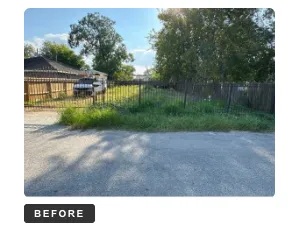
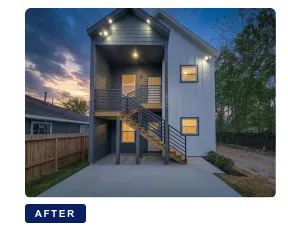
He bought the lot for $95,000 and built a 2,114-square-foot duplex — two units, each 3 bed / 2 bath — in Houston’s 77021. Construction ran $244,620, putting his total cost basis at $339,620. We funded $288,371, roughly 85% loan-to-cost, on our non-dutch draw structure, so he paid interest only on what he’d actually drawn as each phase closed out. The finished duplex sold for $470,000.
The lesson we’d pass to any first-timer: don’t fixate on the builder’s quote alone — watch the timeline. Every extra month of construction compounds your holding costs and eats into profit, so your team’s speed and quality matter as much as the numbers on paper. He got deal #1 right, and we’re now reviewing a four-unit build together.
One $400K Lot, Sixteen New Homes — a Houston Development That Sold for $5.3M
Not every ground-up deal is a single house. This one started as one $400,000 lot in the thick of the Covid market and became a sixteen-home community in southeast Houston.
16 single-family homes · southeast Houston
Our client, Kevan Shelton of Park Street Homes, is a seasoned builder — and he played it patiently. Rather than rushing dirt, he held the land while the market matured, working through the soft costs, engineering, and replatting needed to subdivide a single lot into sixteen individual parcels. Then he built: sixteen well-made single-family homes on ground that used to be one lot.
The project hit every headwind the era had — rising construction costs, crews out sick, and a stretch when plenty of lenders simply paused. We didn’t. We kept the capital flowing on an 18-month construction loan so the build never stalled. By the finish, the sixteen homes appraised at $5.1 million and sold for $5.3 million — on a project that began as a single $400,000 lot. It’s the kind of deal that only works when the lender stays in the foxhole with the builder.
Hear it from Kevan himself — his background in commercial construction, why he builds affordable housing in underserved Houston neighborhoods, and what it took to develop through the pandemic with Tidal Loans behind the project:
Texas Construction Loan Parameters
Loan Details
Frequently Asked Questions
Funds are released through a draw schedule rather than all at once. We disburse money in stages tied to completed milestones — foundation, framing, mechanicals, finish work — and an inspection confirms each stage is done before that draw releases. You typically pay interest only on the funds drawn so far, so your early payments are small and grow as the build progresses.
Experience helps and earns the best terms, because execution is the biggest risk in any build, but first-time builders can still qualify. When a borrower is newer to ground-up construction, we look more closely at the project package and especially the general contractor. A detailed budget, proper plans, and clear permits go a long way toward making a first Texas project fundable.
A fix and flip loan renovates an existing structure, while a ground-up construction loan builds a new one from the ground up. Construction loans rely on detailed plans, permits, and a milestone-based draw schedule, and they generally run longer because building takes more time than renovating. Both are short-term investor loans that exit through a sale or a refinance.
Yes. Build-to-rent is a common use, especially in fast-growing Texas markets. You finance the build with a construction loan, then refinance into long-term financing such as a DSCR loan once the property is complete and leased. The DSCR refinance qualifies on the finished property’s rental income rather than your personal income, making the transition to a permanent hold clean.
Most run twelve to twenty-four months to match a typical build timeline, with the exact term set to fit your project’s scope. They’re short-term by design and meant to be replaced once the structure is finished — paid off by a sale or refinanced into permanent financing. We build in realistic margin so the project has room to reach completion.
We lend statewide. Houston is our home market, but we finance ground-up construction in Dallas, Fort Worth, Austin, San Antonio, El Paso, Corpus Christi, and the surrounding areas. Building costs, lot availability, and permitting vary by market, and we structure each loan to fit the project and the local conditions.
Ready to fund your Texas deal?
Get a fast quote from a direct lender — or call and walk it through with us.