
Multifamily Loans in Texas

AAPL Member · Direct Lender Since 2016 · NMLS #1979189

Texas has one of the deepest apartment markets in the country, and investors across Houston, Dallas–Fort Worth, San Antonio, and Austin are buying, building, and repositioning multi-unit properties at scale. But once a building hits five units, the financing changes — it’s underwritten on the building’s income, not a simple residential formula. Multifamily loans in Texas from Tidal Loans are built for that world: five-or-more-unit properties qualified on the building’s performance rather than your personal paycheck. We’re a Houston-based direct lender and we’ve financed Texas investors since 2016.

A multifamily loan finances an apartment or multi-unit residential building of five units and above, where the property is treated as a small commercial asset. The central question is whether the building’s net income comfortably covers the debt — so the property’s performance, not your personal income, drives the deal. For Texas investors moving up from houses and small plexes into true apartment ownership, it’s the financing that makes the jump possible.

How Texas Multifamily Loans Work

The heart of multifamily underwriting is the debt service coverage ratio on the building — the building’s net operating income divided by its debt payment. A healthy ratio (commonly 1.20 to 1.25 or better) tells us the property pays for itself with room to spare, and a stronger ratio earns better terms. Beyond the ratio, we look at loan-to-value, typically funding a portion of the property’s value and asking you to bring the rest as a down payment — often in the range of 25% to 30% for an acquisition. Because the building’s income carries the loan, the quality and stability of that income — occupancy, lease terms, expense control — matters as much as anything you bring personally. The same DSCR logic powers our single-family Texas DSCR loans, just scaled up to an apartment property.

Types of Texas Multifamily Financing

The most common need is an acquisition loan to buy a stabilized, income-producing building. The second is value-add and bridge financing, where you buy an underperforming building — high vacancy, below-market rents, deferred maintenance — improve it, and refinance once it’s stabilized and worth more; this is where a Texas bridge loan earns its keep. The third is construction, building a small apartment property from the ground up through our Texas construction financing. And the fourth is the refinance — replacing a maturing loan or pulling equity out through a cash-out refinance to redeploy into the next acquisition.

Multifamily Lending Across Texas's Major Markets

We finance apartment deals across all of Texas’s major markets. Houston, our home market, is one of the largest multifamily markets in the nation, with constant acquisition and value-add activity. Dallas–Fort Worth combines strong population growth with deep apartment demand. San Antonio offers more affordable entry prices and steady, military- and tourism-supported occupancy that makes value-add plays attractive. And Austin‘s growth keeps apartment demand high. We also lend across El Paso, Corpus Christi, and the surrounding submarkets statewide.

Small-Balance Multifamily in Texas

Not every Texas apartment deal is a hundred-unit complex, and most of ours aren’t. Small-balance multifamily — buildings roughly in the five-to-twenty-unit range — is a sweet spot for many investors stepping up from single-family and small plexes. These deals are large enough to benefit from commercial-style, income-based underwriting but small enough to remain approachable for an individual investor or a small partnership. They’re a natural progression for someone who has built a Texas single-family portfolio and wants the efficiency of more doors under one roof and one loan.

A Texas Multifamily Deal We Funded: 9-Unit Cash-Out Refi in Humble
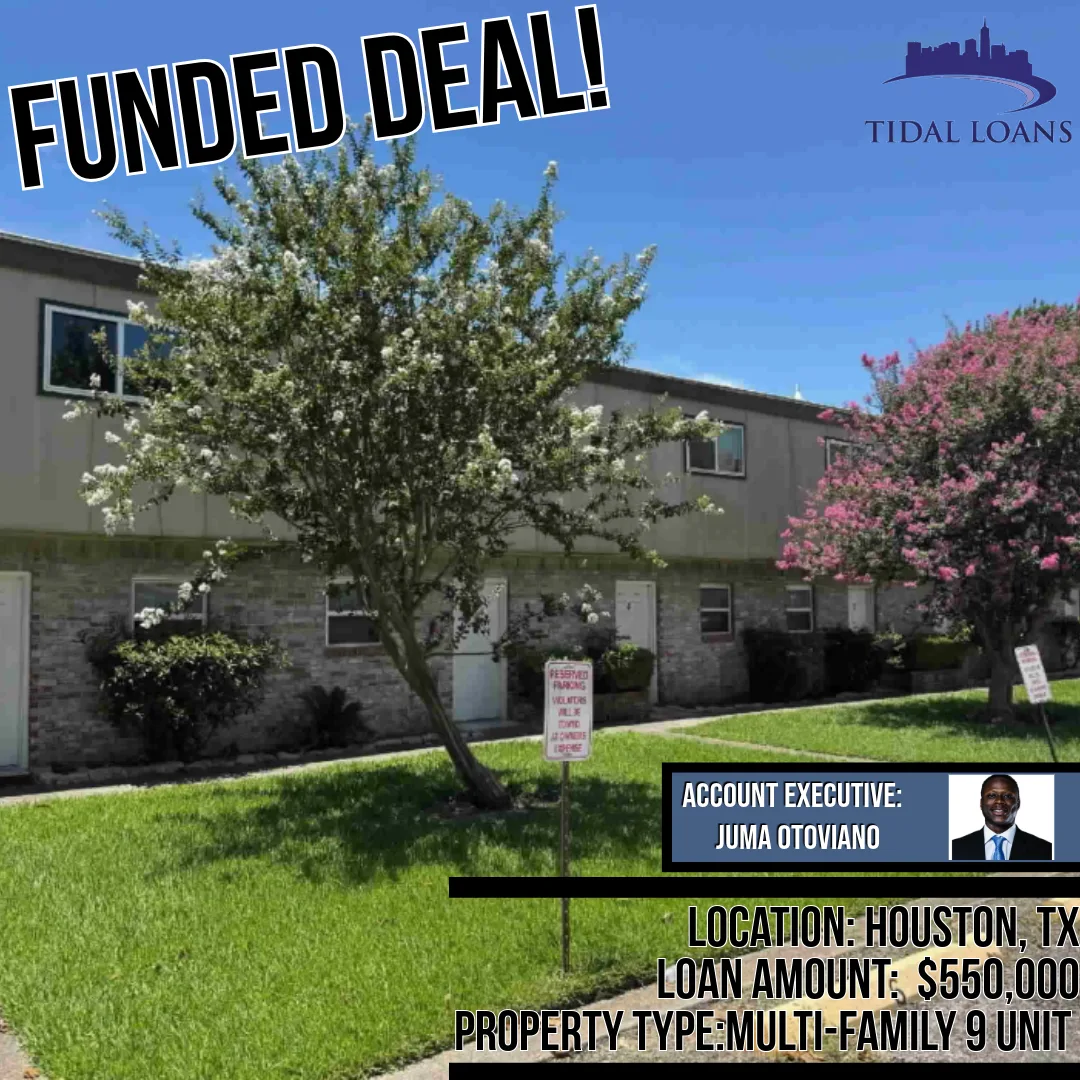
Nine-unit multifamily property in Humble, Texas refinanced with a $550,000 cash-out loan from Tidal Loans

Here’s a recent one that shows how these deals actually come together. An investor owned a 9-unit apartment property in Humble, just inside the Houston metro — bought it with cash, held it a few years, and wanted to reposition it. Six of the nine units needed a full interior gut plus cosmetic work across the building. The problem most owners hit at this point: the equity is locked inside the building, and pulling it out to fund a $500,000 renovation without bringing in a partner or spending personal cash is exactly the kind of deal a conventional lender struggles with.

We structured it as a cash-out refinance. Because the property was owned free and clear, we underwrote the building on its stabilized income — a net operating income of $86,494 at a 7.0% stabilized cap rate — and sized a $550,000 loan that covered 100% of the $500,000 renovation budget out of the building’s own trapped equity. No diluted ownership, and no personal cash into the rehab.

Deal Snapshot

Market: Humble, TX (Houston MSA)

Property: 9-unit multifamily — eight 2-story 2BR/1.5BA units plus one detached 3BR/2.1BA, central HVAC in all units, 18 on-site parking spaces

Loan purpose: Cash-out refinance to fund renovation

Loan amount: $550,000

Underwritten NOI: $86,494

Stabilized cap rate: 7.0%

Renovation budget: $500,000 (full interior gut + cosmetic across 6 of 9 units)

Structure highlight: Cash-out sized so the loan covered 100% of the renovation budget from trapped equity

Because we’re a direct lender with in-house underwriting, we can rush a file when the deal calls for it — on this one, underwriting was completed just three days after we received the appraisal, and it went straight to Cleared to Close so the renovation timeline never slipped. That’s the advantage of underwriting our own multifamily paper instead of routing it to an outside desk. Our leverage on these deals stays competitive with the market, and we size each one to the building’s income and business plan rather than a fixed box. This deal was run by our account executive Juma Otoviano.

Texas Multifamily Loan Requirements

Apartment lending asks more of the property and the operator than single-family financing. The building’s income comes first — its net operating income, occupancy, rent roll, and expense history. The debt service coverage ratio has to work, with stronger ratios earning better pricing. The down payment or equity is generally larger than on a single-family deal, often a quarter to nearly a third of the purchase price. Reserves matter more here too, and experience carries weight — prior multifamily or substantial rental experience strengthens a file, though newer operators can still get financed on smaller, stabilized buildings.

Texas Multifamily Loan Parameters

Loan Details

Property Types5+ unit apartment and mixed-use buildings
Loan TypesAcquisition, value-add/bridge, construction, DSCR, cash-out refinance
MarketsHouston, Dallas, Fort Worth, San Antonio, Austin, and surrounding submarkets
UnderwritingIncome-based (building NOI vs. debt / DSCR)
Down PaymentTypically 25–30% on acquisitions
TermShort-term bridge through long-term options

Frequently Asked Questions

Multifamily loans generally finance buildings of five units or more, which are treated as small commercial assets and underwritten on the property’s income. Two-to-four-unit properties are still considered residential and are typically financed like single-family rentals through a DSCR loan. That five-unit line is the key threshold — it’s where underwriting shifts to an income-and-expense analysis of the whole building.

Down payments on multifamily acquisitions are usually larger than on single-family deals, often 25% to 30% of the purchase price, which sets your loan-to-value. The exact figure depends on the building’s income strength, your experience, and the loan type. A stronger debt service coverage ratio and a stabilized, well-occupied building can improve your terms and leverage.

The building’s. Multifamily lending centers on the property’s net operating income measured against the debt — the debt service coverage ratio — rather than on your personal income or tax returns. A well-run building with steady occupancy and controlled expenses is what drives approval and pricing. Your experience and reserves matter, but the building’s financial performance is the foundation.

Yes. Value-add deals are a major use of multifamily financing. Investors commonly use a bridge loan to acquire an underperforming building, improve occupancy and rents, then refinance into longer-term financing once it’s stabilized and worth more. This lets you create value through better operations rather than just buying an already-perfect building.

Experience helps and strengthens your file, since operating an apartment building is more involved than owning a few rentals, but it isn’t an absolute requirement. Newer operators can often qualify on smaller, stabilized buildings where the income is steady and the plan is straightforward. As deal size and complexity grow, we weigh your track record more heavily.

We lend statewide. Houston is our home market and one of the largest multifamily markets in the country, but we finance apartment deals in Dallas, Fort Worth, San Antonio, Austin, El Paso, Corpus Christi, and the surrounding areas. Each market has its own occupancy and rent dynamics, and we underwrite each building on its specific income and local conditions.

Yes, it’s one of the most common multifamily deals we fund. If you own a Texas apartment building with trapped equity, a cash-out refinance underwritten on the building’s income can pull that equity out to cover a renovation without bringing in a partner or spending personal cash. On a recent 9-unit in the Houston area, we sized the cash-out so the loan covered the entire renovation budget out of the building’s own equity. The building’s stabilized income and value set how much you can pull, and a stronger, well-occupied rent roll gives you more room.

Ready to fund your Texas deal?

Get a fast quote from a direct lender — or call and walk it through with us.

Secret Link